Agentic AI in Open Source ERP: Increasing Efficiency
for SMEs with AI-Powered Solutions
Author: Mark Gutmann
In an increasingly digitalized business world, small
and medium-sized enterprises (SMEs) face the
challenge of keeping up with technological
advancements—without losing sight of cost efficiency
and user-friendliness.
The integration of agentic AI into a company’s ERP
(Enterprise Resource Planning) system opens up
entirely new possibilities, both for internal
processes and customer interactions. Beyond boosting
efficiency, process innovations here can give rise
to entirely new business models.
Compared to traditional ERP solutions, the use of AI
not only increases efficiency but also improves user
experience. Especially for SMEs, which often operate
with limited resources, agentic AI offers an
opportunity to automate repetitive tasks and give
employees more time for strategic activities.
Agentic AI: What’s Behind the Concept?
Agentic AI describes AI systems that are capable of
independently executing tasks, making decisions, and
optimizing processes—in real time. In the context of
ERP, this means the AI doesn’t just process data but
actively contributes to value creation.
Instead of relying on a single, universal AI,
specialized agents can be deployed for different
tasks. For example, one AI agent can automatically
process invoices, while another manages customer
inquiries in the CRM or optimizes inventory levels.
These agents communicate with the ERP system via
seamless API integration, analyze data in real time,
and make intelligent decisions, making business
processes more efficient and less error-prone.
The specialization of these AI agents can be
achieved in two ways: either through
Retrieval-Augmented Generation (RAG), where the AI
is specifically provided with relevant documents and
information, or by training custom models using
fine-tuning. While RAG systems enable quick
adaptation by incorporating external knowledge
sources into their responses, fine-tuning allows for
deeper integration by tailoring the model
specifically to the business processes of the
company. These methods ensure that AI agents make
precise, context-aware decisions that are optimally
tailored to the individual requirements of a
business.
Example 1: Agentic AI for Training and Supporting
Internal Users
Implementing a new ERP system presents many
companies with the challenge of quickly and
efficiently familiarizing their employees with the
new platform. This is where agentic AI solutions
come into play, significantly simplifying not only
onboarding but also ongoing user support. Instead of
spending days reading operating manuals or
participating in extensive training sessions,
internal users can access interactive, AI-driven
training modules.
The AI agents act as personal digital assistants,
providing users with step-by-step guidance in real
time. They can answer questions about specific
features, explain processes, or even guide users
through complex workflows—directly within the ERP
system. If a user, for example, doesn’t know how to
create a new invoice or generate certain reports,
the agent can provide immediate assistance without
the need for additional research.
Furthermore, AI agents enable personalized learning
paths tailored to the individual needs and knowledge
levels of users. Through integration with
communication systems such as email or chat, they
can also proactively provide tips—for example, about
new features or best practices. This significantly
reduces onboarding time and ensures users can
leverage the full potential of the ERP system.
Example 2: Agentic AI in the CRM Module – Automating
Administrative Sales Tasks
A common problem in sales is the lack of maintenance
of the CRM (Customer Relationship Management)
system, as sales staff are often too busy to enter
new customer data or update existing information.
Agentic AI solutions can provide targeted relief by
largely automating administrative activities.
For instance, AI agents can automatically extract
relevant customer data from emails, meetings, or
phone calls and enter it directly into the CRM
system. Through smart interfaces, such as
integration with the email server, incoming messages
can be analyzed and key information—like contact
data, appointments, or inquiry requests—can be
independently captured.
Additionally, AI agents can actively support sales
staff by sending reminders for outstanding entries
or automatically generating follow-up suggestions.
This automation not only improves CRM data quality
but also frees up valuable time for sales staff,
allowing them to focus more on building customer
relationships and the sales process.
Example 3: AI-Powered HR Management Assistant
The AI assistant makes it easier for HR departments
to manage applications, onboard new employees, and
foster talent development. For example, the AI can
analyze application documents and automatically
suggest suitable candidates for open positions by
matching key skills, experience, and job
requirements. For onboarding, the AI creates
customized training plans based on the new
employee’s individual needs. AI-driven
recommendations can also be made for personal career
development or training. This saves time and
increases efficiency across all HR processes.
Example 4: AI for Financial Analysis and Forecasting
This tool uses machine learning to analyze
historical financial data and generate precise
forecasts for the company, such as revenue trends,
cost structures, or liquidity planning. The AI can
detect anomalies in the data—such as unusual
expenses or payment flows—and automatically notify
the relevant staff. Additionally, the system
proposes optimization measures, such as reallocating
budgets or adjusting spending plans. This
application supports decision-makers in making
informed choices and securing the company’s
financial stability.
Example 5: Transcription App for Customer Service
The transcription app uses AI to transcribe incoming
customer service phone calls in real time. During
the conversation, the AI automatically analyzes the
content and structures it into relevant
sections—such as customer concerns, solution
approaches, or open issues. After the call, the
transcription is seamlessly integrated into the CRM
system and added to the customer’s contact history.
The AI can also provide a summary of the
conversation for quick access by employees, making
conversation contents immediately available to other
departments, such as sales or support. Additionally,
the app can recognize and tag important keywords
(e.g., “complaint”, “discount”, “technical issue”),
enabling quick follow-up. This reduces
administrative workload for employees and increases
transparency and traceability of customer
interactions across the entire company.
A Hierarchical AI Chatbot System with Generalist and
Vertical AI Agents
Due to the variety of applications (and thus users
and their requirements), the idea of a hierarchical
AI chatbot system was developed—consisting of a
generalist “first-level bot” and specialized
“vertical AI agents.” This combines the advantages
of broad, generalist capabilities with deep
expertise and modular specialization. This structure
provides a tailored and efficient user experience
for different target groups, such as customers,
internal users, or prospects.
Advantages and Operation of the Multi-Level AI
Approach
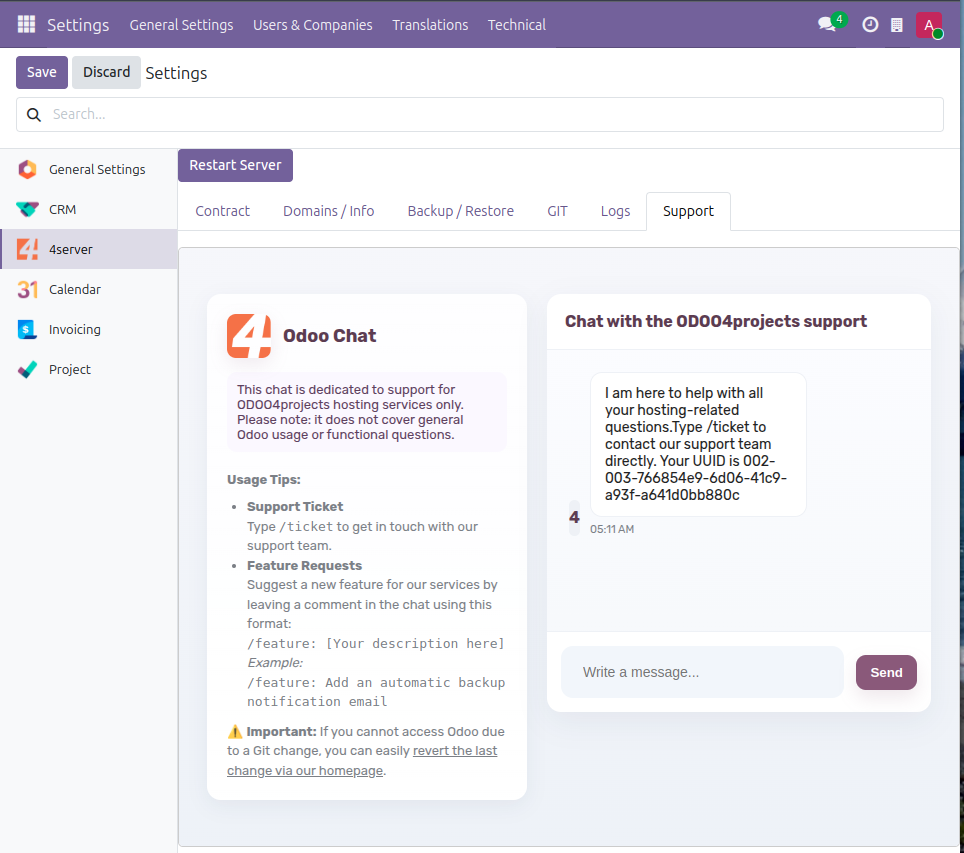
• Generalist First-Level Bot: The
top-level AI chatbot serves as a universal entry
point for users and answers general questions like
“Which modules does the ERP system offer?” or “How
can I contact support?”. It seamlessly forwards
specific inquiries to the relevant vertical AI
agents. Its key feature is the ability to identify
the appropriate bots based on the question and the
available specialized agents.
• Vertical AI Agents with Deep
Expertise: These agents specialize in
individual ERP modules (e.g., CRM, marketing,
logistics) and possess in-depth process knowledge,
which they combine with the specific terminology and
jargon of their respective domains. This enables
them to provide precise answers, explain complex
workflows, or solve problems. They also access data
from adjacent modules to understand and support
cross-functional processes (e.g., integration
between logistics and customer service).
• Seamless Handoffs: A central
advantage of this architecture is the seamless
handoff between the generalist bot and the vertical
bots. The first-level bot identifies the relevant
module and routes the inquiry directly to the
appropriate vertical agent, passing along all
previous communication content. This allows the
vertical agent to enter the context without the user
having to repeat their request, preventing
unnecessary duplication and ensuring a smooth user
experience.
Data Protection and Effort
• License-free open source
LLMs can be used and hosted locally or in a
preferred data center in compliance with GDPR.
• New AI-optimized
hardware already enables powerful interactions
with AI agents at lower financial cost.
Integration and Data Flow
• Vertical AI agents require
access to relevant data and processes of their ERP
modules.
• A central database or API
interface ensures data exchange between bots
and ERP modules.
Context Awareness and Handover
• The first-level bot must
accurately analyze user requests in order to forward
them correctly.
• A robust NLP system/LLM is
required to understand context and intention.
• A central communication
memory enables vertical bots to build upon
previous communication.
Modularity and Scalability
• The architecture must be
modular so that new vertical AI agents can be
easily added.
• The first-level bot should be
regularly updated to be aware of available agents
and their competencies.
Domain-Specific Training
• Vertical AI agents require
training on domain-specific data to understand
technical language and processes.
• Regular updates are necessary
to reflect version changes and new features of the
ERP platform.
User-Friendliness and Feedback
• An intuitive user interface and
the integration of user feedback improve the answer
quality and relevance of the bots.
Mark Gutmann is a freelance AI manager
(IHK), application consultant, and author.
After studying business administration and
linguistics, he spent 25 years in sales and
consulting for leading CX software companies
in the field of intelligent process
automation.
Contact: